

A Minimally Invasive Approach to Early Cavities in Chevy Chase, MD
Curodont is an advanced dental treatment designed to address certain early-stage cavities without the traditional drilling and filling process. Unlike a conventional filling, which involves removing decayed tooth structure and restoring the area with a dental material, Curodont uses a specialized peptide-based formula to support the remineralization of enamel within an early cavity.
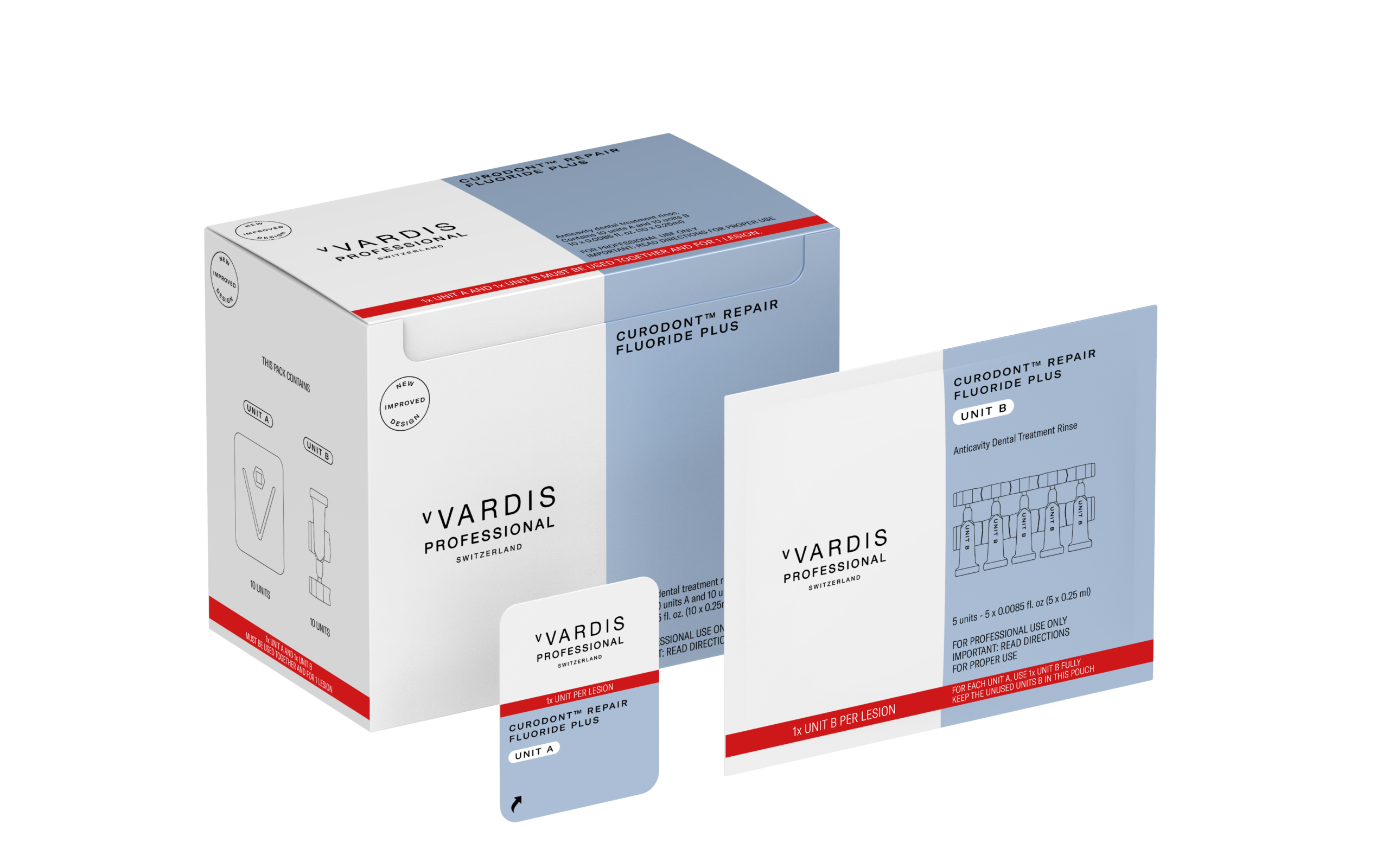
Tooth enamel can lose minerals when acids produced by oral bacteria interact with sugars and carbohydrates in the mouth. This process, known as demineralization, can weaken enamel and eventually lead to a cavity. When decay is identified early enough, treatment may be possible before the damage progresses to a stage that requires a filling.
Curodont is designed to help address this early stage of tooth decay. It is applied directly to the affected area by a dental professional and supports mineral movement into the weakened enamel. The goal is to help arrest or reverse suitable early lesions while preserving natural tooth structure.
Curodont is not appropriate for every cavity. A dental examination is necessary to determine whether the affected tooth can benefit from this approach or needs a traditional restorative treatment.
Healthy enamel is made up primarily of mineral crystals. When acids cause minerals to leave the enamel, the tooth can become weakened. In the earliest stages, the surface may remain intact even though mineral loss has occurred beneath it.
Curodont uses a specialized peptide-based formula designed to support the formation of mineral crystals within these early lesions. The treatment helps minerals naturally present in saliva, including calcium and phosphate, reach the weakened area and contribute to the remineralization process.
The process is intended to strengthen the affected enamel and help stop an early cavity from progressing. Unlike traditional fillings, Curodont does not rely on drilling away the affected tooth structure.
Although the application itself is brief, the remineralization process takes place over time. Follow-up examinations help the dental team evaluate the tooth and determine whether additional treatment is necessary.
Curodont is intended for certain early-stage cavities, particularly lesions where mineral loss has begun but the tooth surface remains sufficiently intact. These lesions may be identified during a routine dental examination or with appropriate diagnostic imaging.
Early enamel lesions can sometimes be managed with non-invasive treatment rather than immediate restorative work. Curodont offers an additional option for eligible cases when a dentist determines that the lesion is appropriate for this approach.
More advanced cavities, areas with significant structural damage, or teeth with symptoms that suggest deeper involvement may require a filling, crown, or another treatment. The best option depends on the depth and location of the decay, the condition of the tooth, and the patient's overall oral health.
Preserving healthy tooth structure is an important goal of conservative dentistry. Because Curodont is designed to treat eligible early lesions without drilling, it may help avoid removing sound enamel during treatment of those lesions.
Curodont is applied directly to the affected area without the conventional drilling used to prepare a tooth for a filling. This may be appealing to patients who feel anxious about dental procedures or prefer a minimally invasive option when clinically appropriate.
Curodont's application generally does not require an injection or local anesthetic. This can make the treatment experience simpler for patients who are nervous about needles or dental drilling. Your dentist will explain what to expect based on your individual needs.
The application of Curodont Repair Fluoride Plus can take approximately five minutes once the tooth has been prepared according to the treatment protocol. The overall appointment may take longer because the dentist must first assess the tooth and prepare the area.
Identifying and addressing tooth decay early can help reduce the likelihood that a small lesion will progress to more extensive damage. Curodont adds another potential option between preventive care alone and traditional restorative treatment.
Your appointment begins with an evaluation of the affected tooth. The dentist reviews the clinical findings and any necessary X-rays to determine the extent of the lesion and whether Curodont is an appropriate option.
If the tooth is suitable for treatment, the affected area is cleaned and prepared according to the product's clinical protocol. The Curodont formula is then applied directly to the early lesion. The application is brief and generally does not require drilling or local anesthetic.
After treatment, your dental team will explain how to care for your teeth and when the area should be checked again. The tooth still needs ongoing monitoring, routine professional care, and good home oral hygiene. If the lesion does not respond as expected or progresses, a different treatment may be recommended.
Curodont is not a replacement for every dental filling. It is designed for selected early-stage cavities where the tooth can still be managed with a non-invasive approach.
Traditional fillings remain an important treatment when decay has progressed beyond the stage that can be managed with remineralization. If a cavity has created a significant hole or compromised the tooth's structure, a filling or another restoration may be necessary to restore function and protect the tooth.
The benefit of a dental examination is that it allows the dentist to explain which options are appropriate for the specific tooth. In suitable cases, Curodont may help preserve natural tooth structure. In other cases, restorative treatment may be the most predictable way to protect the tooth.
Curodont may be appropriate for adults or children with certain early-stage cavities, depending on the clinical findings and the product's indications. It may be worth discussing with your dentist if an early lesion has been detected and you would like to explore options that do not involve traditional drilling.
Curodont may not be appropriate when decay is advanced, the tooth has significant structural damage, or symptoms suggest that the problem extends deeper into the tooth. Your dentist will evaluate the affected area and explain whether Curodont, preventive management, or restorative treatment is most appropriate.
The best way to determine candidacy is through a comprehensive examination and an individualized treatment recommendation.
Curodont can be part of a broader strategy for managing early tooth decay, but it does not replace preventive dental care. Daily brushing with fluoride toothpaste, cleaning between the teeth, limiting frequent exposure to sugary foods and drinks, and attending regular dental examinations all remain important.
Your dentist may also recommend fluoride treatments, dietary changes, or other preventive measures based on your cavity risk and oral health history. If you are more prone to tooth decay, a personalized prevention plan can help address the factors contributing to mineral loss.
At Smiles Elevated, our team emphasizes helping patients understand their oral health and make informed decisions. We take time to explain findings and discuss treatment options so you can feel more confident about the care you receive.
At Smiles Elevated, we focus on personalized dental care that considers both your immediate needs and your long-term oral health. Our team takes a collaborative approach, helping you understand your diagnosis and the options available before making treatment decisions.
If an early cavity is detected, Curodont may be worth discussing as part of your treatment plan. We will evaluate the tooth, explain whether this minimally invasive approach may be suitable, and discuss alternatives if a different treatment is needed.
Our office is located at 5530 Wisconsin Avenue, Suite 1535, Chevy Chase, MD 20815. Call (240) 465-9066 to learn more about your treatment options.
Curodont is designed to treat certain early-stage cavities by supporting the remineralization of weakened enamel. It may help arrest or reverse suitable early lesions before they progress to cavities that require traditional restorative treatment.
Yes, Curodont is designed for eligible early-stage cavities and is applied without conventional drilling. However, it is not suitable for every cavity. More advanced decay may still require a filling or another restoration.
The application is generally comfortable and typically does not require an injection or local anesthetic. Your experience depends on the condition of the tooth and any existing sensitivity.
The application of Curodont Repair Fluoride Plus can take approximately five minutes once the tooth is prepared. The full appointment may take longer because the dentist must evaluate the tooth and prepare the affected area.
Curodont uses a peptide-based formula designed to support mineral movement into early enamel lesions. Minerals such as calcium and phosphate help rebuild mineral crystals within the weakened area over time.
Not in every case. Curodont may be an option for selected early lesions, but cavities with more extensive damage generally need traditional restorative treatment. Your dentist will determine which approach is appropriate.
It may be an option for children with eligible early-stage lesions, depending on the clinical findings and product indications. A dentist should evaluate the tooth and determine whether the treatment is appropriate for the child.
The remineralization process develops over time rather than immediately after application. The visible or measurable changes can vary based on the lesion and individual circumstances. Follow-up examinations help the dentist assess the tooth's response.
No. Curodont may help manage certain early lesions, but it cannot guarantee that a filling will never be needed. Ongoing monitoring is important, and additional treatment may be recommended if decay progresses.
Contact Smiles Elevated to ask about Curodont availability and whether it may be appropriate for your dental needs. Our team can evaluate the affected tooth and discuss suitable treatment options.
Share Your Smile Rewards
Our New Patient Referral Program
Learn More »